AUC and the Port Said Mural – A Personal Plea

From left: Martyr Ahmed Taha, Martyr Karim Adel Khozam, Martyr Mostafa Metwaly, Martyr Karim Junior

From the right: Glory to the Martyrs, Martyr Mohamed Mohsen, Martyr Ahmed Youssef, Martyr Anas, Martyr Mohamed Gamal Mohamed

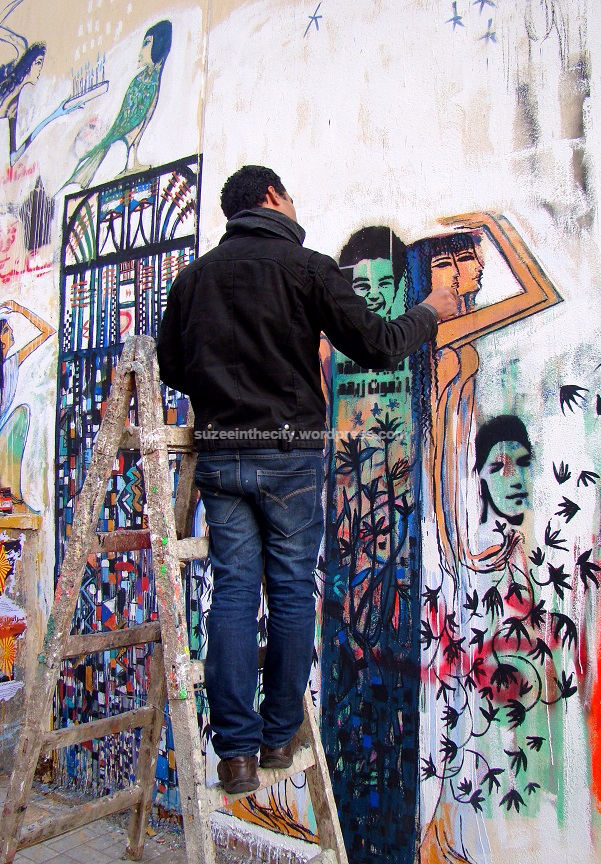
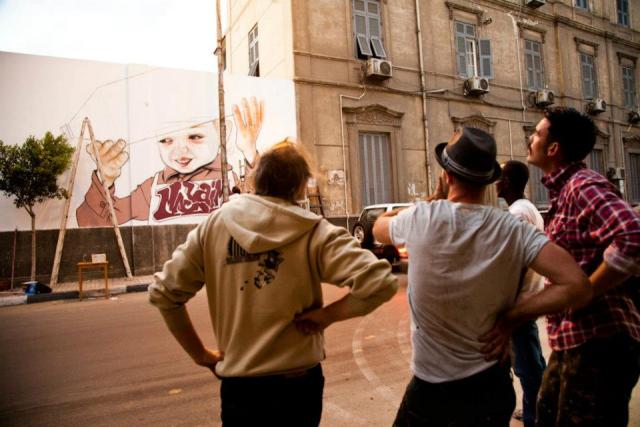
Passersby and journalists eagerly watching Mohamed Alaa at work

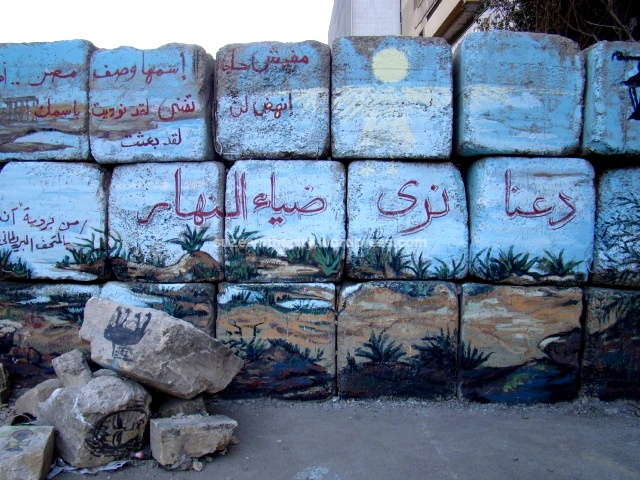
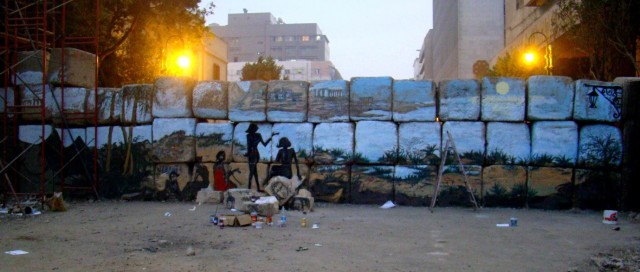
A funny thing happened outside the AUC on Mohamed Mahmoud Street last Thursday. As a group of onlookers, including journalists, photographers, documentary makers and myself, watched Ammar Abo Bakr, Mohamed Alaa and several other artists diligently work away on a mural of the martyrs of the Port Said massacre – a mural they’ve spent almost two weeks painting – a shuttle bus pulled up at the AUC gate and unloaded a group of foreigners in suits, presumably for a conference inside the AUC campus.

As their guide, presumably an AUC rep, stood by awkwardly, the foreigners took out their smartphones and started snapping away at the mural, oohing and aahing in awe at the beauty of the art on display. I watched the AUC rep struggle; here were ‘vandals’ ruining the university wall in broad daylight, and yet he couldn’t yell at them because his visitors were completely enamored. So he laughed and said something along the lines of:

‘Yes, as you can see, our wall was once so small and simple, and now we have this…errr… art after the revolution. So nice.’

The artists, completely nonplussed, continued painting, and when I repeated what he had said to them, Ammar cheekily grinned.

‘Tell him if they paint over this mural, we’ll come back and do it all over again.’

So here is my direct plea to the AUC administration:

Dear AUC,

You will probably not listen to me – why should you? I’m clearly no art expert with any weight to throw around – but please don’t paint over this wall. These artists have worked tirelessly for two weeks to commemorate the deaths of 75 young men, including a student of yours, working days and nights through tear gas and riots to pay tribute to the dead.

This, in my humble opinion, is a masterpiece. And you clearly have bigger things to worry about, such as the fact that every single side street down Mohamed Mahmoud has been blocked by concrete slab walls, or that the military has turned your area into a war zone and has no problem shooting students, doctors or journalists. Or the fact that your Greek Campus SS Building has had a fire on its upper floor, and probably several other properties have been harmed in the past months of clashes. And who knows what more violence the future will bring?

As an institution that teaches art and publishes books on Egyptian art, including one on graffiti soon, please take pride in this mural on your walls, and instead of removing it, protect it. Show it off as a symbol of how your campus was in a pivotal location in so many historical events that have shaped our country for the past year.

But clearly this will fall on deaf ears and you will paint over it all. NB: painting a wall gives a new canvas to a graffiti artist. They will keep coming back. Just so you know. You might as well save the paint. Your effort is futile.

Sincerely,

me

Marwan the Martyr of El Matareya

from the right: Martyr Ahmed Osama, Martyr Mahmoud ElGhandour

At the time of taking this photo, they had yet to write the names of the martyrs

The logo on this martyr's tshirt is the Ultras Ahlawy Logo

Ammar's sketch of the martyr

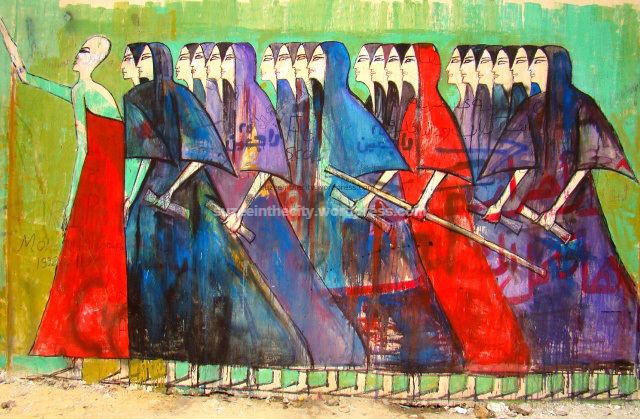
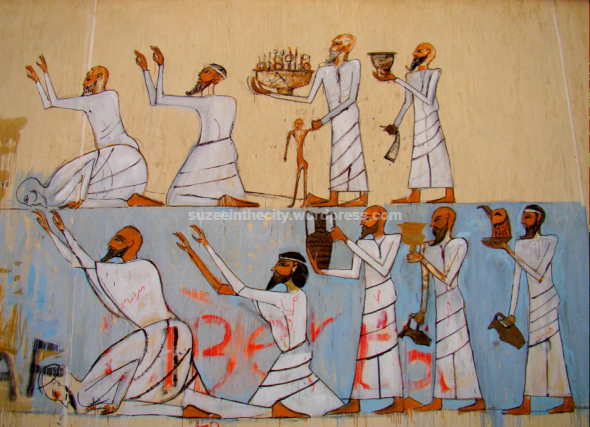
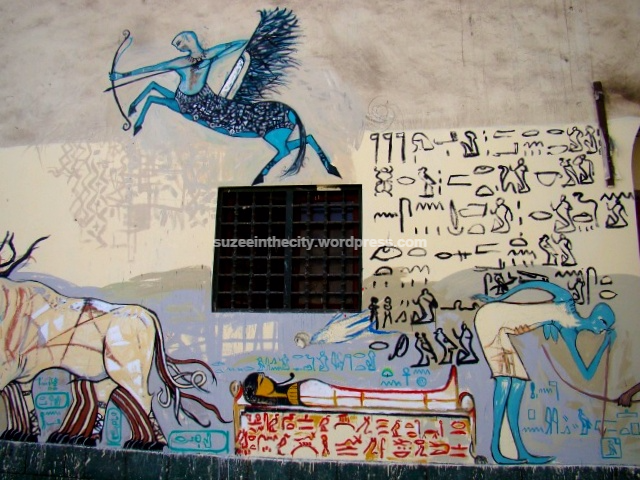
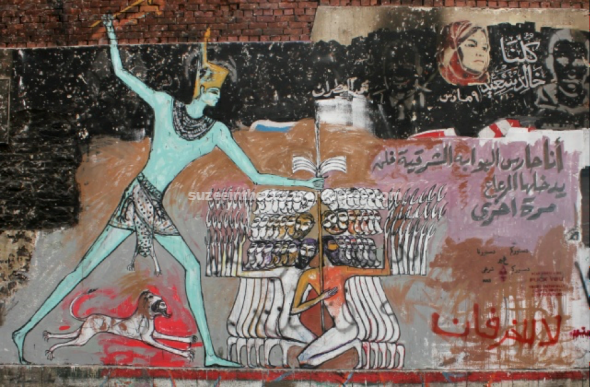
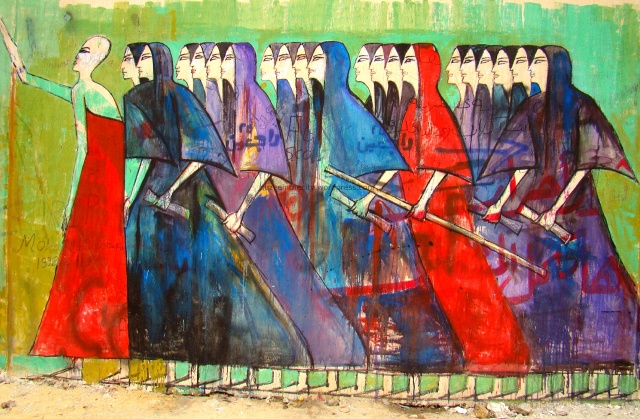
The beautiful Pharaonic mural by Mohamed Alaa

More Pharaonic painting by Mohamed Alaa

And it keeps getting better

by Mohamed Khaled: What does SCAF mean again? It means Thieves, the word against the gun again, and the revolutionaries become baltageya

The other wall next to the AUC entrance, full of faces of martyrs

And the result of the football match was 75million Egyptian martyrs

The wall of Youssef El Guindy full of graffiti

One concrete slab carried this stencil: 'Our revolution is peaceful'

'We donot surrender, either we gain victory or we die' Omar Al Mukhtar

Falaki concrete wall with the faces of Anas, the youngest boy to die in Port Said, at 14 years old.

PS: Dear AUC security guard, I couldn’t care less about your security gate, which you accused me of photographing, when there’s a friggin concrete slab wall blocking off Falaki Street. Bigger picture, dude.

On Mansour Street wall: 'They will not fight you all except within fortified cities or from behind walls. Their violence among themselves is severe. You think they are together, but their hearts are diverse. That is because they are a people who do not reason' Surat Al-Ĥashr 59:14

A quote by Neruda: 'You can crush the flowers, but you cannot stop the Spring from coming.'

On a slab of the Mohamed Mahmoud wall that was pulled down on Feb3: 'We will Continue'

Posted in Street Art Fascination | Tagged , , , , , , , , , , , , | 2 Comments

In the Midst of Madness: Graffiti of the Ultras on Mohamed Mahmoud Street

In the midst of the madness of the night of February 2nd, where thousands of protesters ran through the crowded street of Mohamed Mahmoud amidst the insufferable tear gas fumes filling the air and ominous sounds of gunshots echoing in the night, artist Ammar Abo Bakr quietly painted a mural on the wall of the American University in Cairo. Aided by his friends Mohamed Khaled and Mohamed Alaa, the artist diligently and meticulously painted a mural of some of the martyrs of Port Said, who had died the night before during the terrible massacre after a football match between Al Ahly and Al Masry teams. The unfathomable death toll of over 75 young Ahly football fans had shaken the country. The fans, known as the Ultras Ahlawy, had lost friends as young as fourteen, sparking outrage and anger all over Egypt.

The streets of Downtown Cairo were tense and ominous, faces wrapped in scarves and gas masks as they taunted the Central Security Forces blocking all side streets to the Ministry of Interior and lobbing tear gas at them, chanting ‘Hokooma Weskha! Yawlad El Weskha!’ Dirty government, you sons of dogs. The Ultras Ahlawy said they wanted vengeance for their dead brothers, not from the Al Masry fans, but from the State security forces who had at the very least failed to secure the stadium and at worst, had shut all the gates to prevent the fans from escaping armed attackers, resulting in the horrendous loss of life.

Ammar Abo Bakr from Luxor painted this mural throughout Thursday and Friday night

Ammar is from Luxor, and has regularly traveled to Cairo to take part in the demonstrations and paint on the walls in 2011. He was here during the Cabinet sit-in and the Mohamed Mahmoud clashes where protesters lost their eyes. His tribute to the martyrs and the fighters of the revolution have been profound and essential, not just for the families who’ve lost their children; but for our society’s collective consciousness.

For three consecutive nights on Mohamed Mahmoud, Ammar and his friends worked tirelessly, ignoring jeers by passersby and taking breaks to engage in heated debates with Islamists or to head to the frontline to throw rocks, only to return and resume painting. They are demonstrating artists, or artistic demonstrators.

One moment that I was privileged to observe was on Thursday night, where four young men –barely in their twenties – stopped in front of the mural Ammar was painting of the 19-year-old martyr Mohamed Mostafa, and stood completely transfixed. Then they began to cry.

I asked them what was wrong, and they said ‘He’s our friend; we just came from his burial now.’ And they stared at the mural. Ammar approached them, explained that he wanted to commemorate each and every one of their friends who’d died, and that he’d found their photos on Facebook.

‘If you know any others who died, if you have any photos, please give them to me,’ he pleaded. And they nodded.

It’s one thing to see a massive crowd heaving with incontrollable fury and chants of vengeance, it’s another to see young men completely taken aback and touched by the sight of a beautiful graffiti.

Over the past few days, the media has been quick to pigeon-hole these Ultras Ahlawy as angry, vengeful, aggressive young men who are willing to wreak havoc on the country in vengeance for their friends’ death. At the same time, graffiti is easily typecast as angry protest stencils using profanities and attacks on SCAF, the police and other enemies of the revolution.

What I saw was four young grieving men, touched by the fact that a complete stranger took the time to remember their friend. With over 2000 people dead since 2011, it’s so easy to forget the names and faces and think of them as numbers, shrugging our shoulders and saying ‘Oh only four people died today; that’s not bad.’

The graffiti by Ammar and his friends -made during a breathing battlefield – is a reminder of the valuable lives we’ve lost; the faces that now serve as reminders of the justice that needs to be served to our community. This graffiti did what the members of the Egyptian  parliament and all the politicians failed to do; it put faces to the numbers, and gave them some dignity in their deaths.

The friends of Mohamed Mostafa, an Ultra Ahlawy and a 19 year old student who died on February 1st

Mohamed Mostafa is surrounded by nameless martyrs, all of whom died on February 1st

A scribble next to his face reads 'You're in heaven now, martyr'

Note the green angel wings in the background

I can't read the script clearly but it says something about El Taraf El Talet, or the third entity

Anas is the youngest martyr of the Port Said massacre. He died at just fourteen years old.

A stencil of Anas' face reads 'Either we get their vengeance or we die like them' nest to it is a painting of a martyr called Mahmoud Mohsen

This mural reads 'The Hero', above it is a scribble of 'Down with the SCAF rule'

No SCAF is sprayed on the electricity box, next to it, a small painting of a crescent and a cross

A black band over each frame of the martyrs with orange angel wings behind this face

the Martyr Mahmoud Ghandor, 22-year-old student at Alexandria Faculty of Commerce

Another unknown martyr framed and commemorated

Mohamed Khaled was one of the three artists who worked for three days on the mural

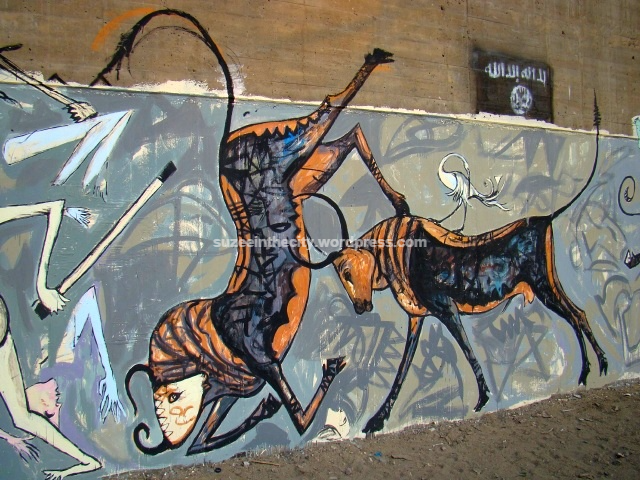
This is Khaled's work, a monster policeman versus a hooded and masked protester

This is the work of Mohamed Alaa, where he incorporated Pharaonic figures into a protest mural

Also presumably by Mohamed Alaa

Liberte, Egalite, Fraternite, with a few doves spread out over the wall

Half Mubarak, Half Tantawi, a graffiti by Arafa, made on February 4

Posted in Street Art Fascination | Tagged , , , , , , , , , , , , , , , , | 3 Comments

War on Graffiti – SCAF Vandalists Versus Graffiti Artists

the original mural by Ganzeer and friends, taken on December 2, 2011

Days after the first anniversary of January 25, tensions between anti-regime activists and loyalists to the SCAF have now reached the cement walls and streets of Cairo.

The graffiti war, a showdown between revolutionary street artists and a fanatical nationalist team who whitewash their work, is a new and disturbing manifestation of pro-Army popular sentiment.

In recent months, activists have used the walls to diligently spread messages denouncing military rule and military trials of thousands of civilians, and calling for another 25 January revolution. At the same time, military loyalists have just as attentively erased these graffiti pieces, leaving their own pro-army and nationalist messages.

This war, completely unimaginable during Mubarak’s time, has come to a head on one wall: Ganzeer’s famous mural of the tank versus bike.

This massive mural under the 6th of October Bridge in Zamalek is considered by many to be the most iconic piece of graffiti in post-revolution Cairo. A collaborative work by graffiti artist Ganzeer and his friends, and a blatant criticism of the Egyptian military, the mural has remained surprisingly untouched since May 2011.

But in early January 2012, unknown artists painted new additions (photo courtesy of @Mosaaberizing) onto the imposing mural, adding a row of protesters carrying ‘V for Vendetta’ masks, a pool of blood under the tank and bodies collapsing under its wheels — a clear reference to the 9 October Maspiro attacks, when Coptic protesters were run over by military APCs, leaving dozens dead.

Interestingly enough, these additions incited a reaction of their own: A group of pro-SCAF civilians called Badr Team 1 vandalized the mural 10 days later, erasing everything they found offensive to the Egyptian army. This meant erasing everything, except for the tank, that is.

In an amateur video allegedly captured on 20 January, Badr Team 1 (who also called themselves the Badr Battalion) accused graffiti artists of being foreign agents and traitors to Egypt. The team called on all honorable Egyptian youth to erase graffiti, as it was “a method for agents and traitors to spread their violent ideologies against the police, the army and Egyptian traditions.”

This rhetoric is all too familiar to Egyptians who, for the past year, have had to listen to SCAF members broadcasting such accusations in the media.

Graffiti has spread like wildfire throughout Cairo in the past 12 months, and is used by young Egyptian activists to commemorate the victims of the uprising, and to raise awareness of political injustices and crimes committed by the Egyptian military. In the face of the mainstream media’s campaign to tarnish protesters as criminals and cover up military crimes, many activists have turned to graffiti as an alternative means of reaching the average Egyptian on the streets.

And while this shaky amateur video produced by these antagonists  of street art can easily be disregarded as a minor incident, the level of ignorance, paranoia and aggression propagated by the video is worrying.

Its incitement of attacks on graffiti artists, though, is sadly a natural consequence of the past months of hostility bred against all forms of criticism of the Egyptian military.

The irony that the dumbasses of Badr Team have made graffiti to denounce graffiti is clearly lost on them. They say members of the April 6 Youth Movement were responsible for the mural, even though an easy internet search would have led them straight to Ganzeer.

The video also shows the stencils of several martyrs’ faces, which were made after the revolution to commemorate those who died during the January 25 revolution. The stencils once carried their names and the words “Glory to God.” Now, the names are erased, and the words read “Glory to Egypt” instead, showing Badr Team’s fanatical nationalism. It seems Egypt is superior to God in their demented heads.

“These drawings contain Masonic and anarchist codes and symbols,” Badr Team’s statement reads. Badr Team circles those “Masonic” symbols drawn by the graffiti artists, including a sad and fat panda, a bird, a child clasping his hands in prayer and the words “Power to the People.”

They are all clear symbols inciting violence, especially the panda.

The V for Vendetta masks — often used by revolutionary artists, most likely as symbols of defying totalitarianism — are particularly bothersome for army loyalists, including the Muslim Brotherhood. It is worth noting here that a recent article in the Brotherhood’s Freedom and Justice Party newspaper warned of anarchists wearing the ‘B for Bendetta’ masks, a spelling mistake that has since been ruthlessly lampooned all over the Egyptian Twitter-sphere.

At any rate, the graffiti community has been quick to respond to attacks by army loyalists, especially the erasure of SCAF’s victims from the famous tank mural. Badr Team 1 had whitewashed all references to SCAF’s atrocities, leaving the solitary tank standing in all its glory with any reference to the Maspiro massacre, the martyrs and the revolutionary protesters wiped out. The words ‘The Army and the Police and the People Are One Hand’ was ironically scrawled nearby.

The green monster is courtesy of the artist Mohamed Khaled

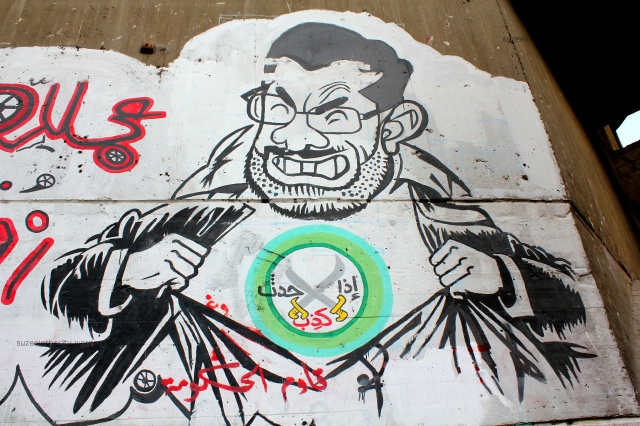
Striking back at Badr Team 1′s pro-SCAF erasure of the mural, a giant green monster of a military policeman chewing on the body of a protester next to stencils of Mona Lisa, Lenin, military leader Hussein Tantawi and other faces were sketched next to the tank. The new additions have been made by a group calling themselves the Mona Lisa Battalion, a tongue-in-cheek hat-tip to the Badr Battalion. The new graffiti faces are whimsical, funny and blatantly political; yet it’s quite possible that the Badr Battalion will not understand that this art is directed at them, that this whole joke is on them.

When asked to comment on the Badr Team video, the original mural’s creator, Ganzeer, said that he was initially happy to have this visual dialogue happening in reaction to the tank mural.

“But when I saw the YouTube video by the ‘Badr Battalion’, I felt a certain kind of sadness that this act was done by a group obviously soaked in ignorance and blind nationalism,” he wrote to me.

“Clearly they’ve been brainwashed by our horrible school textbooks and official media, so brainwashed to the point of stating that ‘The Army, police and people are one hand’.”

Ganzeer couldn’t resist adding the jab, “It’s also obvious that these kids have no sense of aesthetic whatsoever.”

This op-ed has been published in Egypt Independent. You can also read it here.

Posted in Street Art Fascination | Tagged , , , , , , , , , , , , , , , , , , | Leave a comment

January 25 – The Anniversary: Graffiti

Zamalek: Zamalek Corniche

Have You been Vindicated? added next to mural of Tarek Abdel Latif

Don't Forget to Remember El Mosheer (Tantawi), a play on the saying Don't Forget To Remember God

The revolution continues

Ha! The green graffiti reads 'Ninja Uniform for Female Protesters' a jab at the Kasr El Nil protest, where female protesters were beaten then criticised for not dressing modestly

Clean your own brain so that No One Brainwashes You

A new addition by Keizer, after his previous line of work got painted over, opposite Gezirah Club

If You Don't Let Us Dream, We Won't Let You Sleep by Keizer

More by Keizer 'You Wont Like Me Angry'

Riot police by Keizer

Greetings to the Martyrs', a caricature that I originally saw on Facebook now on the walls of 6October Bridge

Ismail Mahmoud Street

Mural by Hany Khaled

A collage of his different stencils, by Zeft. I personally prefer them individually.

By Hany Khaled and Hend Kheera. I think the words are lyrics by Cairokee

Eghdaby (Get Angry), a poster made in honour of the brave women of Tahrir, by 4SprayCans

This is genius: an election campaign poster was torn off except for the words 'For You My Country' and then Tantawi's face was stencilled into the space

The V for Vendetta masks are back with a full vengeance in graffiti, thanks to the media's obsession with them

Killing Can Cause Death

Tantawi the Vampire, note the bullets as fangs

Sad Panda got the last laugh after all. After his poster was torn down just hours after putting it up, he came back and painted a large panda over the remains, writing 'You've Made Me Sadder'

Sad faces, probably painted by Sad Panda

Raise Thinkers not Fighters

The Mona Lisas by Anwar are a recurring theme, they reappear on the Tank graffiti

An eclectic collection of faces: Lenin, Mona Lisa, Tantawi and that actor who was always in Ismail Yaseen's films. What's his name?

'Some Kids' 'So What, Nothing Wrong With That' featuring Ismail Yaseen

El Gabaleya Street

Ganzeer's tank graffiti has had some redecoration after pro-SCAF vandals wiped out all figures and left the scribbles 'The Police, Army &People Are One Hand'

A big green policemonster was added by unknown artists after the Pro-SCAF whitewashed everything

The Mona Lisa Batalion is possibly the answer to the Badr Batalion that vandalised the tank graffiti

All of SCAF's generals are thieves

Downtown Cairo: Mahmoud Bassiony Street

On Mahmoud Bassiony Street

Remembering Mina Daniel in graffiti

Baradei: The revolution will triumph in the end

Freedom for Michael Nabil above Where is the Bread, Freedom, Social Justice?

Workers of Egypt, Where Are You?

Kazeboon, Down with Military Junta, Jan 25

Posted in Uncategorized | 3 Comments

Conversation with Ganzeer: the Tank, Buddha and Mad Graffiti Week

If you Google search Cairo Street Art, Ganzeer’s name is your top result. Countless interviews and features on the artist follow. As arguably the most recognized name on Cairo’s art scene today, it’s no surprise that Ganzeer is the most sought-after interview subject and reference on graffiti in Cairo.

Ganzeer has been wary of the media’s fixation on him for the last ten months. He hasn’t made graffiti in Egypt since May 2011, and has since spent his time on a multitude of political and art projects outside the realm of graffiti. And if you didn’t get the hint already, his website opens with the block letters I AM NOT A STREET ARTIST OR GRAFFITI ARTIST.

Why was it important for him to literally spell it out?

‘How long have you known me?’ he asks.

‘Ten years.’

‘Over ten years, how long have I spent working as a graffiti artist?’

‘Very little of it.’

‘How long have I worked as an artist?’

‘All of it?’

‘There you go,’ he answers. ‘The problem is, because there’s a freaky media frenzy about the revolution and street art, journalists who have no idea about anything I’ve done before, they only care about: ‘So tell me about street art in the revolution.’ At the end of the day, if it’s not exactly who you are, there’s no point in being identified as it.’

‘Do you feel boxed in when people describe you as a graffiti artist?’

‘No, it’s just I’m not a street artist; that’s not what I do,’ he says. ‘For example, Keizer, you said in your blog, that’s what he does for a living, how he eat/breathes street art. But that’s not how my brain functions, and it would be unfair to Keizer to describe me as a street artist.’

As the most interviewed and quoted artist on revolution street art, does Ganzeer think the attention is due to his portfolio of art including his graffiti or because of that much publicized arrest for this poster?

‘I don’t think this has anything to do with my portfolio of work, unfortunately, or my very limited street art portfolio,’ he shrugs bashfully. ‘I doubt I would have gotten as much publicity if I hadn’t been arrested.’

The arrest pretty much killed any anonymity that he had left, and the news coverage revealed his face and his real name: Mohamed Fahmy.

‘Does the lack of anonymity bother you?’

‘I have a perspective on being anonymous,’ he answers. ‘I don’t believe that street art should be illegal. I don’t want to treat it like I’m doing something illegal or wrong, it’s my right to do it.’

‘That’s a bit ironic considering you were arrested.’

‘Yes but I was arrested not because I was doing street art but because of the content of the street art. Ironically, the people [on the street] demanded my arrest and the army had to come [to arrest me], otherwise I would have continued normally. ‘

‘One year on from Tahrir, what’s happening with the martyr mural project? Have you given up on it? What’s the deal?’

‘The deal is because of current circumstances, I felt responsibility to get more involved in other things, so I suppose you could say that it’s on hold,’ he says. ‘I knew it was a big ambitious project but I thought it would be a lifetime project, something that will take five  or six years to complete.’

‘The mural of Islam Raafat in Bustan was painted on a public toilet, which some thought to be disrespectful for a martyr.’

‘My view that a public toilet shouldn’t be seen as something 3eeb or dirty,’ he says. ‘And the fact that it is in our culture, shows how our culture has degenerated, just assuming that a bathroom is a bad thing. It shouldn’t be. Having a martyr on a public toilet is counteracting a generational culture.’

‘What about Mad Graffiti Weekend?

‘My experience with Mad Graffiti was great. It’s impossible to do murals of that size on your own; so team work is essential. I think if one is a little anal about it and has to work in isolation without any collaboration whatsoever, you’re definitely missing out on the benefits of group work. Funnily enough, few of the people who helped out on my murals were artists. I guess we could work together in the same space, but I don’t think we could collaborate on one piece.’

Ganzeer’s arrest sent out waves of panic and wariness among a lot of people, including artists like Keizer and Sad Panda, who said that his arrest made them very apprehensive about going out and working.

‘Yeah but neither of them made Freedom Mask,’ he argues. ‘One makes Snow White with a machine gun, the other draws sad pandas. They’re not going to get arrested for their work. You don’t get arrested for drawing on a wall; you get arrested for the content of your art. And both in terms of their content are really safe.’

‘Like many other street artists, you don’t feel the need to sign your street art. Why not?’

‘Well the Buddha said.’

‘Really?’

‘Really.’

‘Keep going.’

‘I have a spiritual side, you know.’ He laughs. ‘Buddha said there are three things you can’t hide: The sun the moon and the truth. Or something to that effect. Eventually the truth will come out and people will know. The point of graffiti is the art itself; you don’t want people to be distracted by the signature. That’s how I look at it. The important thing is to get the message out.’

‘What about graffiti that has no message?’

‘That’s bullshit. Art in general that has no message is bullshit. It’s wasting the artist’s time, it’s wasting people’s time. So you’re inspired, but what does your art mean? It’s like in Exit to the Gift Shop, where Mr. Brainwash takes photos of Elvis Presley and adds toy guns. It’s just putting pop art cultural references together. It’s not what any street artist would do. It’s just aesthetic. So although I don’t subscribe to that type of street art I would say that in general there’s a benefit to all types of street art in that it adapts to urbanism and modern architecture.’

‘What’s the connection between the current street art scene and the city’s architecture?’

‘If I was to look at the city now in terms of its buildings and the magazine or a book there’s no connection whatsoever in the way people dress. If you look at middle aged Arabian architecture, you’d see a connection between the architecture and the design of a Koran or a carpet and the way people are dressed, there’s a connection. It’s not completely schizophrenic and detached. The way we live now is like that. But when people start forcing street art onto architecture, they are surrounding people in the city by other element of this culture. So some of this art may be reminiscent of something you’ve seen in a movie like Pulp Fiction and Tawfiq el Dekken with Ismail Yaseen or stuff from magazines; it has to exist. You can’t live in an environment that’s totally detached from the culture.’

‘How do you respond to graffiti artists who’ve criticised you for being in the limelight? You’re not exactly underground or enigmatic on the street art scene.’

‘I find it weird when some artists call me an attention seeker,’ he says, ‘When I’ve been the only one of the bunch refusing to be in shows or exhibitions like ‘This Is Not Graffiti‘ or documentaries. I’m just saying.’

Six Contributions Ganzeer Made to the Cairo Art Scene

  1. Cairo Street Art Map: Ganzeer enabled a Google Map on his blog that helped other graffiti artists and fans pinpoint the exact location of graffiti around Cairo. This map immensely helped fans like myself track down the new pieces.
  2. Tank Versus Bike: The largest graffiti to be made in post-revolution Cairo, and one of the longest surviving pieces, this mural was the result of group effort, where friends and fellow artists helped Ganzeer finish it over several hours. The symbolism of the piece is so self-evident; it’s startling that it has survived this long without being painted over by SCAF loyalists. Recently, unknown artists added civilians falling under the moving tank; a poignant reference to the tragic events of Maspiro in October.
  3. Mad Graffiti Weekend: The first collective graffiti campaign launched in May 2011 via social media to encourage collaborating and making street art in the open. Before this weekend, few of the graffiti artists had met and collaborated on street art.
  4. Martyr’s Mural Project: Ganzeer tapped into the need to commemorate the martyrs of the first 18 days of Jan25 by launching a project to make a mural of each. Three were completed: Islam Raafat on Tahrir Street, Seif Allah Mustafa in front of the High Court, and Tarek Abdel Latif in Zamalek next to the Gezirah Sporting Club.
  5. Getting Arrest: Ganzeer’s brief arrest in May 26, 2011 for sticking this poster on Downtown Cairo walls caused public outrage and a swift media reaction that may have led to his quick release. Outed to the press as Mohamed Fahmy, he gave TV interviews afterwards, nonchalant about his face or true identity being exposed. He made it ok to be a publicly recognized graffiti artist; the opposing pole to the underground/Banksy persona that others maintain.
  6. Mad Graffiti Week: After laying low on the graffiti scene for a few months, Ganzeer is now back with an open call to another graffiti event this January, 2012, to use art as a means of exposing the lies fed by the SCAF to the Egyptian people. ‘Our only hope right now is to destroy the military council using the weapon of art,’ he wrote on his blog. ‘From January 13 to 25, the streets of Egypt will see an explosion of anti-military street-art. If you are a street artist elsewhere in the world, please do what you can in your city to help us.’

PS: he makes good pasta salad.

Posted in Street Art Fascination | Tagged , , , , , , , , , , , , , , , , , , , , | 12 Comments

The Revolution Continues… And So Does Graffiti

This amazing mural of the injured protesters of November 19 is on Mohamed Mahmoud Street, on the wall of the AUC Main Campus, which saw the heaviest battle between protesters and police soldiers ten days ago

The wall carries eight faces of those injured during the protests. The real number of those who lost their eyes during the latest waves of protests is estimated at over 60 people.

Once again, graffiti has returned to the streets of Tahrir and the Mogama’ building as Egyptian demonstrators flooded back to the Square on November 19th. The street art covers layers of previous graffiti on the walls of Mohamed Mahmoud Street, only this time the tone is more sombre, calling for the freedom of jailed activists, commemorating those who lost their eyes or died during the November 19 protests, and denouncing the regime for the atrocities and injustice it is responsible for.

The revival of the Tahrir protests has inspired these many artists to reclaim the walls; some are veterans of Tahrir such as Hosni, Hany Khaled and El Teneen. Others are new, and not concerned with leaving their names as they are with getting their message across.

The revolution may not be tweeted; but it may be recorded through graffiti.

Graffiti stencil of the Lion statue on Kasr El Nil Bridge with an eye patch.

Yosri Fouda once again gets the graffiti treatment

Dance to the tunes of the revolution, Not emergency law

The Hear/See/Speak No Evil Trio

Graffiti of activists Alaa Abdel Fatah and Mina Daniel side by side. The first stencil calls for Abdel Fatah to be set free, while the second states 'We Are All Mina Daniel', inspired by 'We Are All Khaled Said', the facebook group that helped launch the January 25th protests.

Graffiti of Khaled Said's face next to it 'Khaled Mesh Said' or Khaled Is Not Happy. It's sad to see his face back on the walls next to those of other dead and injured protesters.

These blocks of stone block Mohamed Mahmoud Street at the AUC Greek Campus Library. Behind it and on both sidestreets, APCs and armed soldiers laze about. The wall reads 'Freedom Must Come'

Your Silence is Killing Us, it reads. Above a neglected blanket on the corner of Mohamed Mahmoud Street

'Ehna Beto3 Tahrir', We are the people from Tahrir, is a play on the title of 70s film 'Ehna Beto3 El Autobees' We're the people from the bus, starring Adel Imam and Abdel Moneim Madbouly. Their faces are stencilled here.

Graffiti of Alia El Mahdy (the nude revolutionary) &Samira Ibrahim, who is taking SCAF to trial over her being subjected to virginity tests in March. The text roughly translates to Samira was forced to take her clothes &be subjected to a virginity test by soldiers, with zero public or media interest. Alia El Mahdy took off her clothes willingly and her nude photos were viewed by 3million.

Graffiti stencil reads 'Even if he lost both eyes, he'll still be a lion. Long Live Egypt's Lions'

Graffiti of Ahmed Harara, a protester who has lost both his eyes in Tahrir, the first on November 28, the second on November 19.

‘”]

'Vote for the Revolution, symbol [Gas Mask

On Magles El Shaab Street

'The Revolution of the grandsons will bring back the glory'

Graffiti stencil of Maspiro Building by El Teneen, text reads OccupyMaspiro

On the corner of Mohamed Mahmoud Street, green mural reads 'Mosheer's Martyrs Street, formerly Mohamed Mahmoud'. Next to it the handcuffed fists read 'Freedom Must Come'

SCAF’”]

Mural by Hosni: 'Fill in the dots: [expletive

Graffiti stencil 'Wanted: Hamdy Badeen' SCAF council member

Graffiti of a cow on Mohamed Mahmoud Street, below it is a song. But I'll need your help translating it.

'Down with the Thieving Military Council' mural by Hosni.

Next to sleeping protesters, the mural by Hosni reads 'Tear Gas and Bullets, Thank God!'

Mural by Hend Kheera and Hany Khaled, next to the wall where Khaled had made a mural during the July 2011 sit-in. Talk about Deja Vu.

A People that Makes Half a Revolution is a People that Will Get S-C-R-E-W-E-D

No Reconciliation: collage of faces including Khaled Said, Alaa Abdel Fatah, Mina Daniel and Others

'Statement Nr.1 from the People to SCAF: LEAVE'

Below a stencil of Che Guevara, the baton-wheeling Policeman reads 'We ARe Back'

'Revolution' on Mohamed Mahmoud Street

Posted in Street Art Fascination | Tagged , , , , , , , , , , , , , , , , , | 8 Comments

The Wave Against Graffiti – We Ba3deen?

Graffiti is not meant to be permanent; but it is meant to produce a reaction, even if that reaction means removing it because it’s offensive, or an eyesore.  However, when you’re a Faculty of Fine Arts in Cairo that teaches art, it’s a little strange that you remove the post-jan25 graffiti your students and friends have made on your walls, no?

For ten months, the walls of the Faculty of Fine Arts in Zamalek carried these colourful murals made in the spirit of Tahrir and January 25 presumably after the revolution. You could call them cheesy or amateur or beautiful; either way, these pieces reflected a poignant time in Cairo where young people displayed their hopes and aspirations on the walls. Perhaps the faculty is just an institution that demands order and cleanliness, and views this street art as vandalism.

So in early October, I noticed that all the walls had been painted clean. Instead of being disappointed, the graffiti artists probably appreciated this clean, new canvas.

Because the next day, I came back and found this.

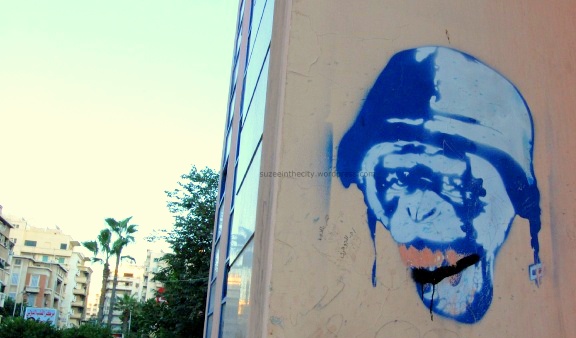
Man pointing gun at TV, the logo is Al Oula, one of the leading State TV channels that has spread false propaganda and misinformation, notably during the events of Maspiro on October 9.

Sadly, that was also painted over days later. However, the wall’s primary location and it being right next to the Faculty means good luck to anyone trying to stop graffiti from being made here. Unless the army comes to guard it like they did with the Tahrir garden. Hmm.

Someone accidently (or not) painted over the dot on Qa3et El 3ard. Now it reads Qa3et el 3ars. (evil giggle)

I’m not quite sure who goes around removing graffiti in Cairo, but I doubt it’s the police or government that’s taking the time – given the pathetic condition our walls are now in after the parliamentary election posters and stickers, I hardly think clean walls are at the top of their list of concerns.

That being said, I’ve noticed anti-SCAF or anti-Mubarak regime graffiti being removed, which worries me as that means that more people are convinced that protesters=bad, tahrir=destroying country, SCAF= good people who occasionally lose control over their APCs that get taken by drugged up protesters for a joyride. But that’s state media for you.

Here are a few examples of protest graffiti being removed, or in some cases altered to mean something completely different.

This graffiti in Zamalek once read 'Hang, Hang Hosni Mubarak', now it merely reads 'Mubarak'

This stencil by Keizer originally read 'Justice will be Served today, Adly'. The sentence has been sprayed over, and now there's a heart next to Adly

This graffiti stencil reads 'No To Military Tribunals' and has been spread around Cairo by activists and graffiti artists like El Teneen. This is one of several along the same road in Dokki to be blackened out.

Mural by Hani Khaled on Mohamed Mahmoud Street listing the demands of the May 27 protests, including Justice for the dead and rehabilitation of the State Media

This mural by Hani Khaled was half-painted over, so that the list of protester demands was removed, but the rest of the colourful mural remained.

Spotted in early October

This stencil, also by HK, originally read 'Down with El Mosheer', now reads 'He will not Fall'

Another example is this stencil on the wall of the Giza-Bahr A’zam tunnel, which originally read ‘Yaskot El Mosheer’ or Down with El Mosheer, refering to Tantawy. Someone sprayed a ‘Lan’ above it so that the whole message changed into a pro-SCAF graffiti.

Graffiti of Ismail Yaseen and Tawfiq El Dekken on Tahrir Street was painted over, apparently with black shoe shine

It doesn’t neccessarily need to be political either: this graffiti stencil made by Charles Akl and Amr Gamal was, according to the stoy I heard, painted over by the shoe-shiner stationed next to the wall. Increasingly tired with people taking photos of the wall, he decided to hide the faces with his shoe shine. Akl and Gamal replicated this very image in the exhibition ThisIsNotGraffiti, perhaps as a statement on the reaction to street art.

This graffiti of a rat figure by Shank was inexplicably half-painted over. Someone apparently thought the figure too offensive. If you're going to remove graffiti, you might as well do a decent job and paint the whole wall clean.

Shank’s original graffiti stencil can be seen here.

Of all the graffiti artists to be targeted, Sad Panda is one of the most defaced, in my humble opinion. Possibly that’s because many of his stencil are highly political and touch on raw subjects like the holy status SCAF has gained in this country.

This poster made by Sad Panda here was plastered on the wall of Merghani Bridge in Heliopolis. It shows an army helmet carrying a royal crown with the Egyptian flag symbol of the eagle ontop. The message is clear; which is probably why it got torn off pretty quickly.

Photo courtesy of Sad Panda

Barely a trace left of the poster on Merghani Bridge.

This stencil and the poster of the rope-skipping girl with her mouth taped over was made on the wall of a public toilet on Tahrir Street across from El Horreya. The words read ‘El Mosheer has made me sadder’. The poster was partially torn off.

Photo courtesy of Sad Panda

But most signifcantly, this stencil of an army soldier placing a baby into the fire was removed hours later. I know this because the stencil was made on the wall of the AUC Library on Mohamed Mahmoud street, and Sad Panda was confronted by some angry citizens while making it. When I showed up hours later to photograph it, it had already been painted over.

Photo courtesy of Sad Panda


Posted in Street Art Fascination | Tagged , , , , , , , , , , , , , , , , , , | 2 Comments